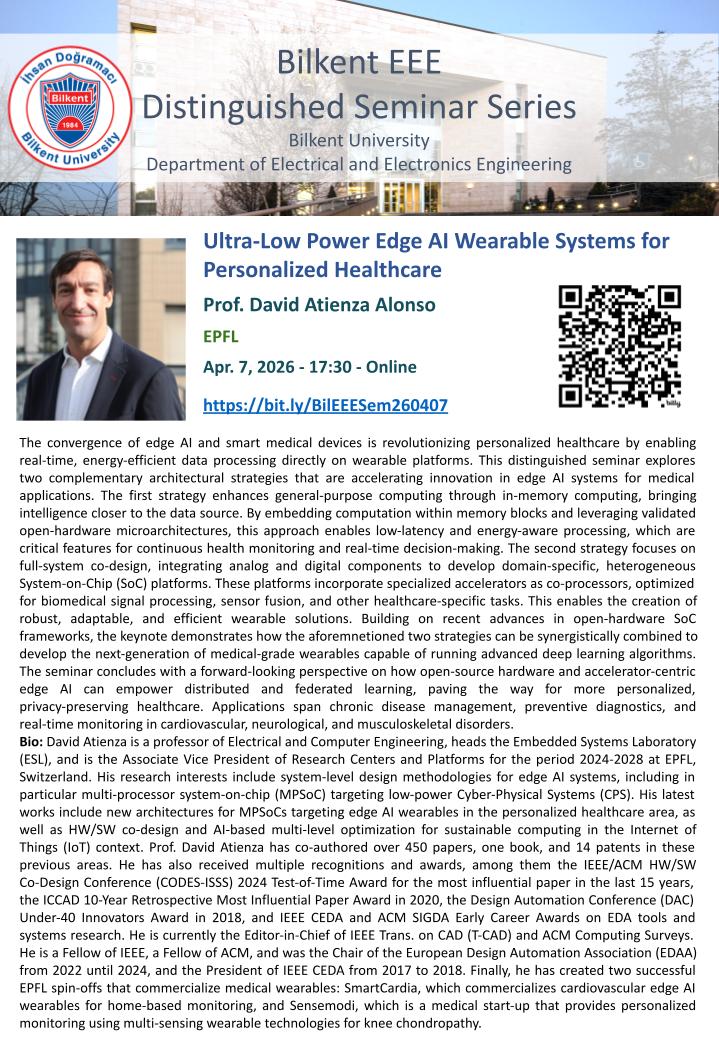
Prof. David Atienza Alonso
EPFL
Date/Time: Apr 7, 2026 – 17:30 – Online
Zoom Link: https://zoom.us/j/97924975840
Meeting ID: 979 2497 5840
Ultra-Low Power Edge AI Wearable Systems for Personalized Healthcare
The convergence of edge AI and smart medical devices is revolutionizing personalized healthcare by enabling real-time, energy-efficient data processing directly on wearable platforms. This distinguished seminar explores two complementary architectural strategies that are accelerating innovation in edge AI systems for medical applications.
The first strategy enhances general-purpose computing through in-memory computing, bringing intelligence closer to the data source. By embedding computation within memory blocks and leveraging validated open-hardware microarchitectures, this approach enables low-latency and energy-aware processing, which are critical features for continuous health monitoring and real-time decision-making.
The second strategy focuses on full-system co-design, integrating analog and digital components to develop domain-specific, heterogeneous System-on-Chip (SoC) platforms. These platforms incorporate specialized accelerators as co-processors, optimized for biomedical signal processing, sensor fusion, and other healthcare-specific tasks. This enables the creation of robust, adaptable, and efficient wearable solutions.
Building on recent advances in open-hardware SoC frameworks, the keynote demonstrates how the aforemnetioned two strategies can be synergistically combined to develop the next-generation of medical-grade wearables capable of running advanced deep learning algorithms. The seminar concludes with a forward-looking perspective on how open-source hardware and accelerator-centric edge AI can empower distributed and federated learning, paving the way for more personalized, privacy-preserving healthcare. Applications span chronic disease management, preventive diagnostics, and real-time monitoring in cardiovascular, neurological, and musculoskeletal disorders.
Bio: David Atienza is a professor of Electrical and Computer Engineering, heads the Embedded Systems Laboratory (ESL), and is the Associate Vice President of Research Centers and Platforms for the period 2024-2028 at EPFL, Switzerland. His research interests include system-level design methodologies for edge AI systems, including in particular multi-processor system-on-chip (MPSoC) targeting low-power Cyber-Physical Systems (CPS). His latest works include new architectures for MPSoCs targeting edge AI wearables in the personalized healthcare area, as well as HW/SW co-design and AI-based multi-level optimization for sustainable computing in the Internet of Things (IoT) context.
Prof. David Atienza has co-authored over 450 papers, one book, and 14 patents in these previous areas. He has also received multiple recognitions and awards, among them the IEEE/ACM HW/SW Co-Design Conference (CODES-ISSS) 2024 Test-of-Time Award for the most influential paper in the last 15 years, the ICCAD 10-Year Retrospective Most Influential Paper Award in 2020, the Design Automation Conference (DAC) Under-40 Innovators Award in 2018, and IEEE CEDA and ACM SIGDA Early Career Awards on EDA tools and systems research. He is currently the Editor-in-Chief of IEEE Trans. on CAD (T-CAD) and ACM Computing Surveys. He is a Fellow of IEEE, a Fellow of ACM, and was the Chair of the European Design Automation Association (EDAA) from 2022 until 2024, and the President of IEEE CEDA from 2017 to 2018. Finally, he has created two successful EPFL spin-offs that commercialize medical wearables: SmartCardia, which commercializes cardiovascular edge AI wearables for home-based monitoring, and Sensemodi, which is a medical start-up that provides personalized monitoring using multi-sensing wearable technologies for knee chondropathy.